FROM THE STUDY
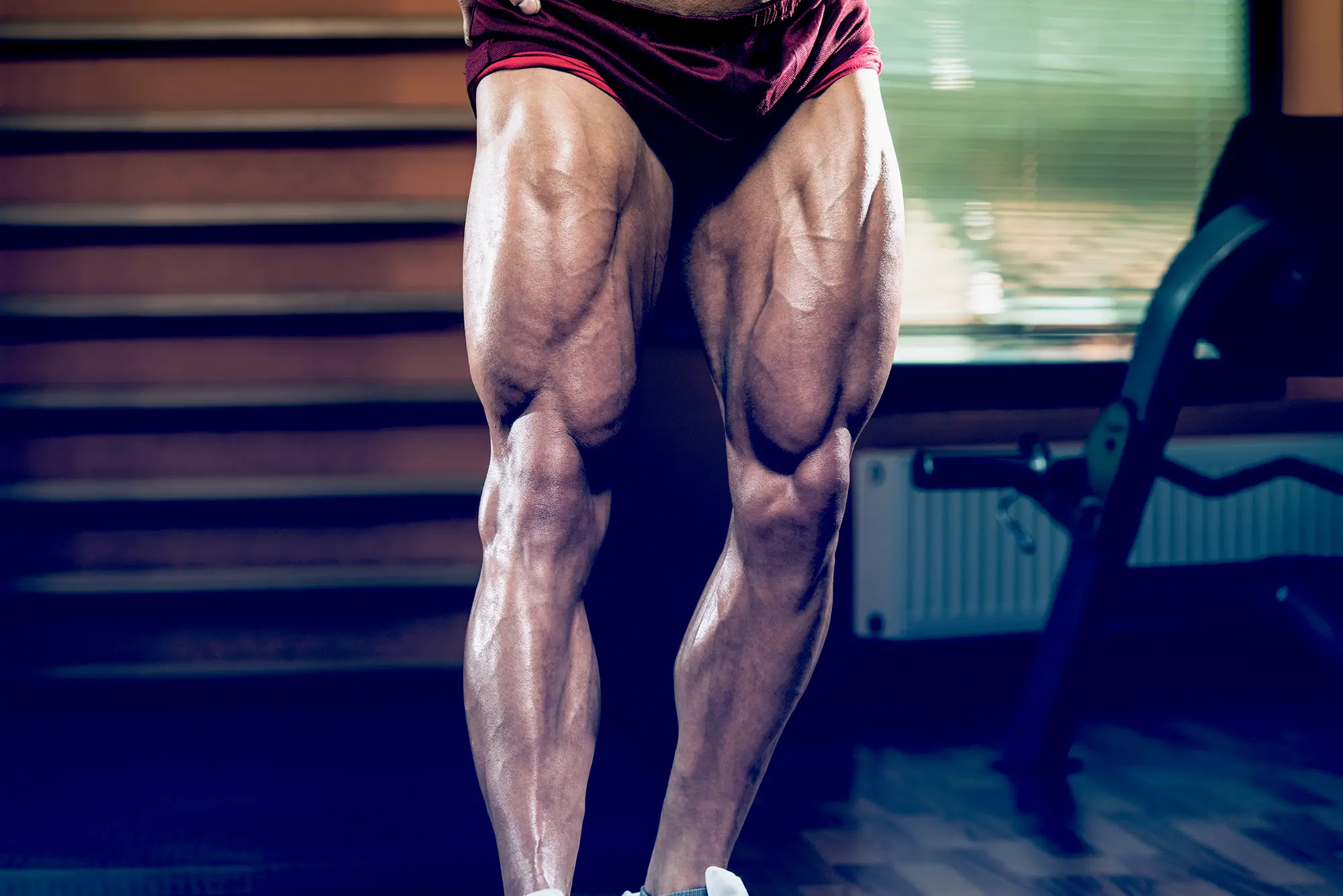
Leg press works more muscles than a knee extension, so it should build more, right? But "working" a muscle and "growing" it aren't necessarily the same thing. A 12-week study trained one leg on each machine, scanned all 17 lower-limb muscles with MRI, and found the answer splits by muscle rather than crowning a winner.
Overview
- What did they test? The researchers tested whether single-joint knee extension (KE) or multi-joint leg press (LP) builds more muscle in the quads specifically and the lower limb overall. Seventeen untrained adults trained one leg on each for 12 weeks (70% 1RM). Magnetic resonance imaging (MRI) was used to measure muscle volume change in 17 lower-limb muscles.
- What did they find? It splits by muscle. The rectus femoris grew after KE (+13.2%) but not LP (+1.1%) — a statistically significant difference between exercises. The vasti and whole QF grew significantly under both, with no significant difference between them (QF +7.1% vs +4.9%). LP also drove significant growth KE didn't produce at all: gluteus maximus (+15.4%) and adductor magnus (+6.2%), yielding significantly more total lower-limb growth (+6.3% vs +2.8%).
- What does it mean for you? Leg press produced comparable vasti and whole-QF growth to knee extension while also hypertrophying the gluteus maximus and adductor magnus, so for overall lower-limb volume, it covers more muscles per session. However, knee extension grew the rectus femoris significantly more than leg press (which barely changed it at all), so the two exercises can serve different purposes, or complement one another for the best overall growth rather than one replacing the other.
What’s the Problem?
Resistance exercises can be grouped into two categories: single-joint movements that isolate one muscle or group, and multi-joint movements that drive several muscles across multiple joints at once. To build the quadriceps femoris (QF) — the largest muscle group in the body — lifters commonly choose a single-joint knee extension (KE), multi-joint leg press (LP), and squats. The intuitive assumption is that the multi-joint option, by recruiting more muscles, should build more. But the evidence for that has been surprisingly thin and indirect. A recent meta-analysis found similar hypertrophy between single- and multi-joint training overall 1, but most of the included studies trained upper-limb muscles and leaned on crude size proxies like arm circumference. The MRI-based work that does exist points to a more nuanced, muscle-specific picture: KE has preferentially grown the rectus femoris over the vasti 2 3, while squats have primarily grown the vasti 4. The catch is that these studies examined KE or multi-joint work in isolation, never head-to-head. The two trials that did compare them directly 5 6— and suggested KE favors the rectus femoris while LP/squat favor the vastus lateralis — ran only 5–8 weeks and relied on ultrasound muscle thickness, which correlates poorly with MRI-derived whole-muscle volume and can miss regional growth 7. So two questions remained genuinely open: which exercise better grows the individual QF heads and the QF as a whole, and — since LP theoretically involves the hips — which other muscles LP actually hypertrophies.
Purpose
To directly compare the hypertrophic effects of knee extension and leg press on the quadriceps femoris and other lower-limb muscles (Experiment 1), and to assess muscle excitation during each exercise to test whether it explains any hypertrophy differences (Experiment 2).
Hypothesis
The authors predicted that (1) QF hypertrophy, particularly the rectus femoris, would be greater after KE than LP; (2) LP would additionally grow other lower-limb muscles (e.g., hip extensors), producing greater overall lower-limb growth than KE; and (3) muscle excitation would broadly support and explain these hypertrophic differences.
What Did They Test and How?
If you would like to continue reading...
New from Biolayne
Reps: A Biolayne Research Review
Only $12.99 per month
- Stay up to date with monthly reviews of the latest nutrition and exercise research translated into articles that are easy for anyone to understand.
- Receive a free copy of How To Read Research, A Biolayne Guide
- Learn the facts from simplified research
About the author
Cody Haun
Cody Haun completed his Bachelor's and Master's Degrees at East Tennessee State University where he studied Exercise and Sport Physiology alongside his work as a strength and conditioning coach. During this time, Cody developed a keen interest in physiology and nutrition. Cody went on to complete his PhD from Auburn University with a concentration in...[Continue]
More From Cody