How do muscles actually grow — and what really matters for hypertrophy?
In this episode, I break down muscle growth from the ground up, starting with muscle structure and working all the way through the practical training variables that actually drive hypertrophy.
We cover how muscle fibers are built, why muscle cells are uniquely multi-nucleated, and how satellite cells and myonuclei influence growth potential and long-term adaptations (including the concept of “muscle memory”). From there, we dig into how resistance training shifts net protein balance, why muscle protein synthesis and breakdown both rise with training, and why hypertrophy is often delayed when people first start lifting.
A major focus of this episode is mechanotransduction — how mechanical loading from resistance training is converted into chemical signals that stimulate muscle growth. We unpack what we know (and don’t know) about mTOR signaling, phosphatidic acid, kinase pathways, and why mechanical tension is the primary driver of hypertrophy.
From there, the episode gets highly practical. We break down:
• Why proximity to failure matters more than load
• How volume really works (and why “dose-dependent” doesn’t mean linear)
• The role of training frequency and how to distribute volume
• Why stretch and lengthened positions matter for growth
• Load and rep ranges for hypertrophy vs strength
• Exercise selection, machines vs free weights, and compound vs isolation lifts
• Rep tempo, intensity techniques, and what doesn’t meaningfully affect growth
• Why systemic hormone spikes from training don’t predict hypertrophy
I close with clear, evidence-based takeaways you can actually apply: how hard to train, how much volume most people need, when failure makes sense, how to structure exercises, and how to prioritize effort, recovery, and adherence over gimmicks.
If you want a science-based framework for building muscle — without myths, hype, or unnecessary complexity — this episode lays it out step by step.
Muscle structure & function
Muscles are bundles of fibers. Each fiber is an individual cell
- Fibers have a heterogeneous structure. 1
- Sarcoplasm
- Sarcolemma
- Sarcoplasmic reticulum
- Myonuclei
- Fibers are unique as they are one of the only multi-nucleated cells in the body. 1
- Myonuclear domain theory
- Each myonuclei controls protein synthesis for a specific surface area. 2 3
- Muscular hypertrophy can increase myonuclear domain, indicating increased transcriptional capacity but it is believed this is capped. 4
- Larger type II fibers have larger myonuclear domains whereas smaller type I oxidative fibers have smaller myonuclear domains. 5
- Each myonuclei controls protein synthesis for a specific surface area. 2 3
- Satellite cells
- Sit between the sarcolemma on the cell surface & the basal lamina sheath. 1 2
- These cells can fuse to form new myonuclei. 2
- It is thought that satellite cell number may predict muscle potential. 5
- Resistance training increases satellite cell fusion & myonuclei number. 6
- Anabolic steroids increase satellite cell fusion. 7
- Fusion of new myonuclei increases the capacity for protein synthesis. 3
- May explain ‘muscle memory’
- Once a myonuclei fuses, it is unlikely to unfuse during atrophy unless the reduction in stimulus is longer term. 8 9
- Mice treated with testosterone retained more myonuclei and increased muscle mass faster (31% faster) when returning to resistance training compared to mice never treated with testosterone. 10
- Implications for drug testing in sports. 6
- Implications for trans athletes as males have more satellite cells than women. 11
- May explain ‘muscle memory’
- Myonuclear domain theory
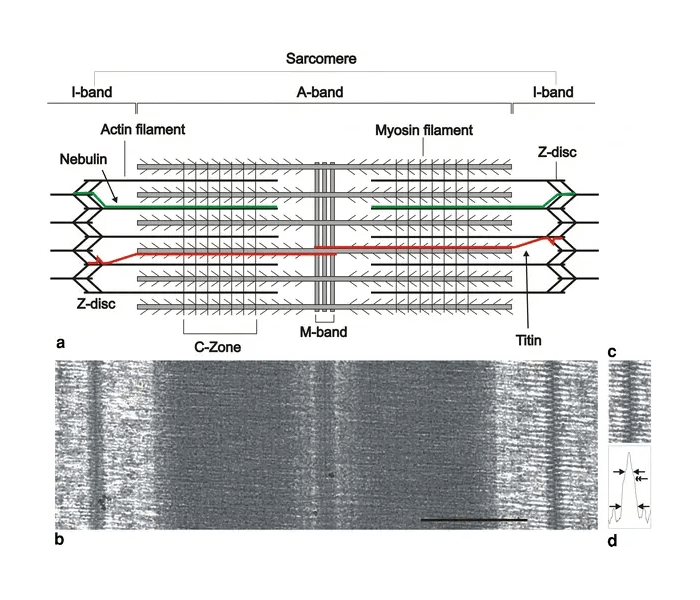
- Fibers consist of a myriad of different proteins with sarcomeres as the contractile units of muscle fibers arranged in sequence. 12
- Main contractile proteins are actin & myosin. 11
- Actin is anchored to the Z disk. 11
- Myosin is attached to the M band in the middle of the sarcomere.11 It is also anchored by an enormous protein called Titin that spans the length of the sarcomere from the Z-disk to the M band & provides stability while anchoring myosin in place. 11
- Cross-bridging of actin & myosin causes contraction. 11
Figure 13
Muscle growth
Referred to as Muscle Hypertrophy (there is also hyperplasia)
- Increase in muscle cell size
- Can be due to increase in myofibrillar components, cytoplasmic proteins, mitochondria, or fluid
- For muscle hypertrophy to occur, there must be increased deposition of protein or an increase in Net Protein Balance (NPB)
- NPB is the balance between muscle protein synthesis (MPS) and muscle protein breakdown (MPB)
- NPB = MPS – MPB
- Resistance training increases both MPS & MPB. 14 15 16
- Untrained individuals incur a greater increase in MPB compared to trained individuals. It is thought this increased MPB is to facilitate remodeling of skeletal muscle & may be why hypertrophy from resistance training has a slightly delayed effect when people begin. 16
- Trained individuals have a similar peak response of MPS to training but the effect is a much shorter duration than untrained individuals. 17
Figure 18

What causes muscles to grow?
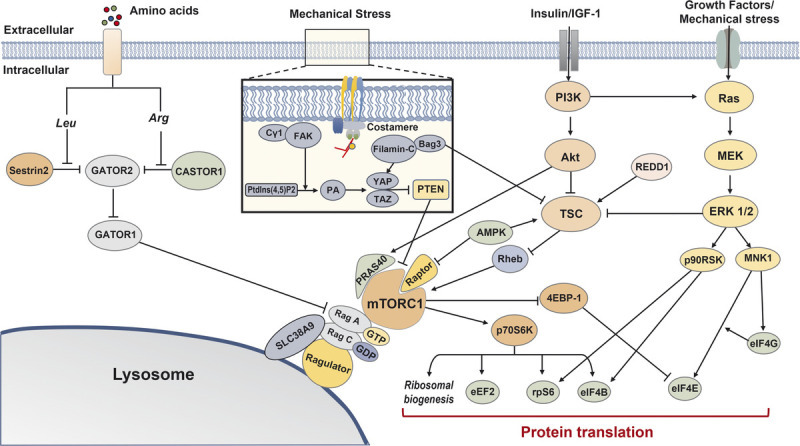
Mechanotransduction: MPS must > MPB but the stimulation of MPS & protein turnover is a chemical signal. Somehow, the mechanical stimulus of resistance training must be converted into a chemical signal that activates cellular protein turnover. This is mechanotransduction (MTD)
- The mechanisms involved in MTD are not well understood
- It is well established that mechanical loading from resistance training increases the activation of mTORC1, which increases MPS through translation initiation.
- It is less clear how mTORC1 is activated from mechanical stimuli
- It is thought to involve the formation of phosphatidic acid (PA) in the costamere of the Z-disk. PA has been demonstrated to stimulate mTORC1 activation. 19 20
- In parallel, mechanical stimuli also activate RAS kinases & a subsequent signaling cascade that activates ERK1/ERK2, which subsequently activate p90S6K & MNK1. MNK1 can phosphorylate eIF4G, increasing the formation of eIF4F, the rate limiting step of translation initiation. p90S6K phosphorylates 4E-BP1 & rpS6, both of which increase translation initiation. 21
- There is also evidence that mechanotransduction may occur through ion channels but this is poorly understood. 22
- It is well established that mechanical loading from resistance training increases the activation of mTORC1, which increases MPS through translation initiation.
What is the most important factor to create this? Mechanical tension
- Other factors may matter for growth, such as metabolic stress, muscle damage, & hormones but these appear to have minimal to no effect on hypertrophy in the absence of sufficient mechanical tension. 23
Figure 21
Mechanical tension
Forces placed on the muscle
- Active tension – when muscles are contracting from cross bridges between actin and myosin
- Passive tension – when muscles are being stretched
How to initiate mechanical tension
- Requires sufficient intensity, ie, proximity to failure
- Mechanical tension is cumulative throughout a set, training session, & training sessions
The importance of intensity for hypertrophy
- Research demonstrates greater hypertrophy with sets taken closer to failure. 24
- Interestingly, strength gains do not appear to be dependent on proximity to failure. 24
- Reaching absolute muscular failure does not appear to be a requirement for maximizing muscular growth, but getting within a few reps appears critical. 25 26 27
- Most people do not understand where their true failure is and even trained individuals underestimate their point of failure by 5-6 reps in research studies. 28
Training volume
- Volume Load = weight lifted x reps x sets.
- Better definition of volume = number of hard sets (sets of sufficient intensity, close to failure)
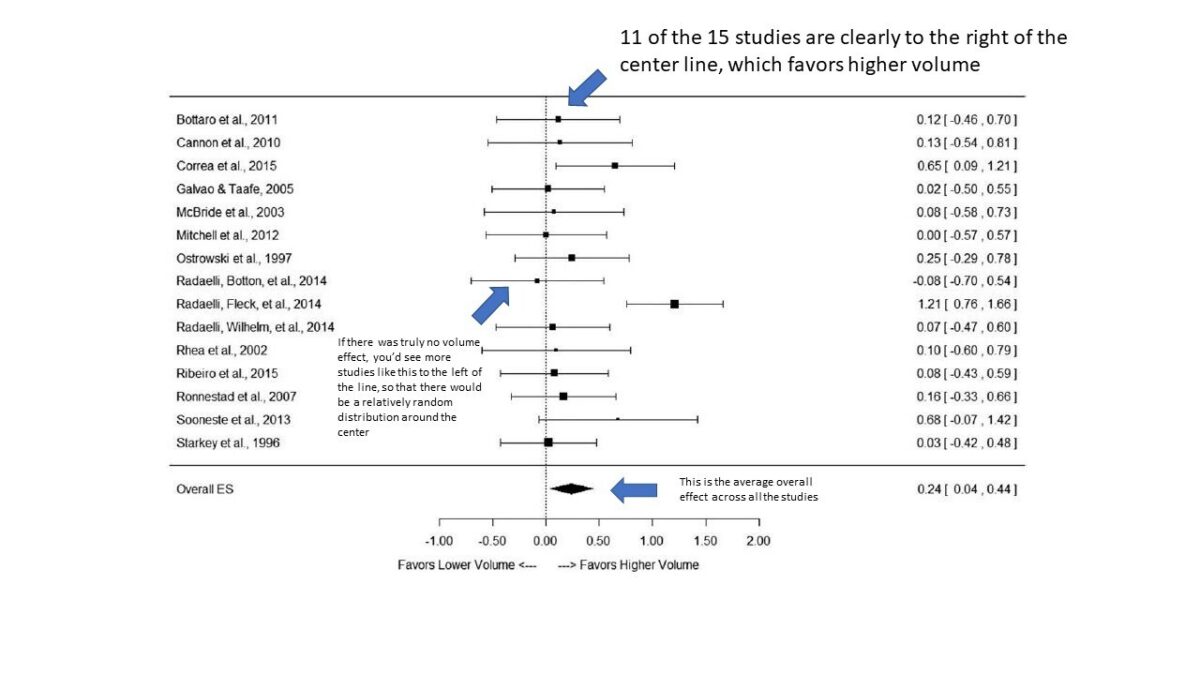
- Meta-analysis clearly show superiority of multiple hard sets vs. single hard sets on muscular hypertrophy. 29
- If intensity is the drug, volume is the dose of the drug
- Higher training volumes appear to increase hypertrophy in a dose-dependant manner. 30 31 32
- Dose-dependent does not mean linear. The majority of the hypertrophic response occurs in the first few sets with increasing hypertrophy with subsequent sets, but diminishing returns. As of now, we have yet to see a hard ‘cap’ for hypertrophy with training volume.
Figures 32

Figure courtesy James Krieger 33
Frequency
- Training frequency appears less important for hypertrophy compared to intensity & volume. There is a trend towards better hypertrophy with more frequency, but it appears that frequency is primarily a tool to distribute volume, but some studies demonstrate better hypertrophy with 2x/week frequency vs 1x/week frequency for body parts even when volume & intensity are equated. 34
- Interestingly, strength appears to have a greater relationship with training frequency than hypertrophy. 32
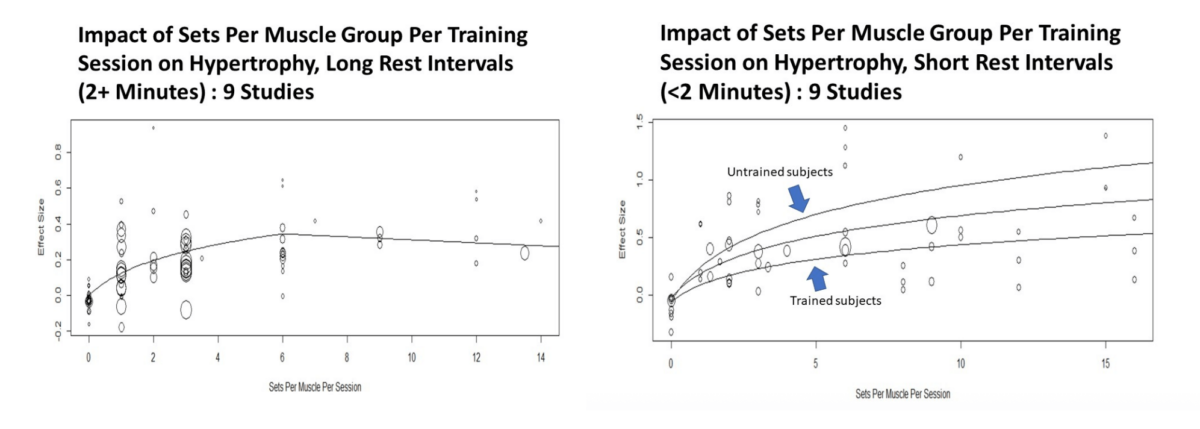
- There is evidence that the per session hypertrophy response caps out at 6-12 sets for a body part with no further hypertrophy or stimulation of MPS beyond this point.
- This appears to be impacted by rest periods. Shorter rest periods (<2 min between sets) require more sets to maximize hypertrophy in a session (~12) while longer rest periods (>2 min between sets) appear to maximize hypertrophy around 6 sets in a session per body part. 35
- This is in alignment with MPS data demonstrating the MPS response to training appears to cap out around 6-12 sets per body part in both humans and rodents. 36 37
- It may be useful, therefore to limit sessions to ~10 sets per body part & gain additional training volume through additional sessions/frequency
Figures courtesy James Krieger 33
Muscle stretch
- Numerous studies have demonstrated full range of motion (ROM) training is superior to partial ROM training in a shortened position. 38
- However, when partial ROM is performed in the lengthened position, it produces similar hypertrophy to full ROM training. 39 40
- Static stretching has also been demonstrated to induce hypertrophy in the absence of load. 41 42 43
- Thus, in addition to load, stretch may be an important component of mechanical tension to induce hypertrophy
Load & reps
- Differences in load do not appear to produce differences in hypertrophy when set volumes & intensity are equated between treatments over a wide range of repetitions (30-90% of 1RM, around ~3-30 reps) while gains in maximal strength appear to be load dependent. 44 45
- This indicates that mechanical tension is cumulative & the hypertrophy can be induced by a wide range of repetitions.
- While prevailing thinking was that slow twitch muscles may respond better to low load, high rep training & fast twitch muscles may respond better to high load, low rep training, there appears to be no difference in hypertrophy between these muscles when volume & intensity are matched. 46
- This is supported by muscle activation data demonstrating similar activation of muscles regardless of load used when sets are taken to failure. 47
Exercise selection and order
- There don’t appear to be any MUST DO exercises.
- Various exercises for body parts appear to result in similar overall hypertrophy.
- Compound exercises appear to produce similar overall hypertrophy to isolation exercises when volume and intensity are matched. 48 49
- While overall hypertrophy is the same, there may be regional differences in muscle hypertrophy with compound vs. isolation exercises. 50
- Compound exercises appear to produce more muscle activation at similar relative intensity and may produce greater strength. 49 51
- Machines produce similar hypertrophy to free weights when volume and intensity are matched. 52
- Compound exercises appear to produce similar overall hypertrophy to isolation exercises when volume and intensity are matched. 48 49
- Exercise order also appears not to make a difference for muscle hypertrophy when volume & intensity are matched. 53
- Regional hypertrophy differences were found with mid-quad thickness being greater in subjects who did a compound leg exercise before an isolation exercise, however. 54
- It likely makes sense to therefore include a diverse array of exercises, both compound & isolation, to maximize hypertrophy while deferring to individual personal preferences to maximize adherence.
Rep Tempo
- Rep tempo does not seem to matter much for hypertrophy as muscle growth is similar for rep durations of 0.5-8s. 55
- Rep tempo does not seem to matter unless they are extremely short or extremely long, with both producing less hypertrophy, though long reps may reduce muscle strength, especially slow concentric reps. 56
- Slow eccentrics also do not appear to influence hypertrophy as slow eccentrics of >2s produce similar results as fast eccentrics of <2s, and they both produce similar strength gains, but slow eccentrics were worse for jump performance. 57
Other things that appear to result in no difference in hypertrophy when volume & intensity are matched:
- Periodization. Although strength gains are better with periodized programs compared to non-periodized programs. 58
- Undulating periodization outperformed linear periodization in trained lifters.
- Intensity techniques: drop sets, supersets, rest pause, pre-exhaust, eccentric overload, and forced reps appear to produce similar hypertrophy when volume is matched and sets are sufficiently intense 59 60 61 62 63
Systemic hormones & hypertrophy
- For many years the prevailing thought was that the systemic rises in testosterone, growth hormone (GH), & insulin-like growth factor-1 (IGF-1) were the drivers of muscular hypertrophy.
- Recommendations included training large movements like squats in order to grow other body parts since large compound movements may result in greater hormonal responses.
- These rises in hormones are very short in duration (1-2 hours)
- Research has overwhelmingly demonstrated that acute rises in hormones from training do not predict hypertrophy or strength gains. 64 65
- In fact, it is only the acute rise in cortisol in response to resistance training that has any association with hypertrophy. 66
Practical takeaways
Perform sets of sufficient intensity
- Most sets should be performed within ~2 reps of failure
- Isolation exercises should be taken closer to failure while compound exercises may be able to achieve similar results slightly further from failure
- Taking sets to absolute failure should be reserved for the final set of an exercise & preferably isolation exercises
Perform enough volume ie enough hard sets for your goal
- Most hypertrophy benefits can be achieved with 4-6 hard sets per week per body part
- For maximal hypertrophy, it may be necessary to exceed 20 sets per week for a muscle growth & possibly more
- It may be useful to distribute high set numbers over multiple training days & there is evidence that multiple training days per week frequency is superior to a single day
Take a muscle into a stretched position
- Either full ROM or lengthened partials
- Shortened partials are inferior
Exercise selection & order
- Use a variety of compound & isolation exercises to maximize hypertrophy
- Prioritize compound exercises first
- Use exercises that the individual enjoys
Other
- Rep tempo should be fast enough to use a good load but slow enough to be in control of the weight
- Use a variety of repetition ranges for novelty & hypertrophy
- Prioritize lower rep movements with compound exercises & higher rep movements with isolation exercises
- Utilize opposing muscle supersets to cut down on time
- While no impact on short-term hypertrophy, varying rep schemes & programming strength-specific phases may possibly lead to longer-term improvements. Using periodization may help facilitate this
References
- Skeletal muscle structure, function, and plasticity
- The Myonuclear Domain in Adult Skeletal Muscle Fibres: Past, Present, and Future
- The control of cell mass and replication. The DNA unit–a personal 20-year study
- Satellite Cell Depletion Disrupts Transcriptional Coordination and Muscle Adaptation to Exercise
- Myonuclear domain size and myosin isoform expression in muscle fibres from mammals representing a 100,000-fold difference in body size
- Resistance exercise training promotes fiber type-specific myonuclear adaptations in older adults
- Higher Myonuclei Density in Muscle Fibers Persists Among Former Users of Anabolic Androgenic Steroids
- Muscle mass and strength gains following 6 months of resistance type exercise training are only partly preserved within one year with autonomous exercise continuation in older adults
- Satellite cell depletion does not inhibit adult skeletal muscle regrowth following unloading-induced atrophy
- A cellular memory mechanism aids overload hypertrophy in muscle long after an episodic exposure to anabolic steroids
- The Satellite Cell in Male and Female, Developing and Adult Mouse Muscle: Distinct Stem Cells for Growth and Regeneration
- Section IIThe Organization, Structure, and Function of Muscle
- The vertebrate muscle Z-disc: sarcomere anchor for structure and signaling
- Human muscle protein synthesis and breakdown during and after exercise
- Skeletal muscle and resistance exercise training; the role of protein synthesis in recovery and remodeling
- Assessing the Role of Muscle Protein Breakdown in Response to Nutrition and Exercise in Humans
- A review of resistance training-induced changes in skeletal muscle protein synthesis and their contribution to hypertrophy
- A review of resistance training-induced changes in skeletal muscle protein synthesis and their contribution to hypertrophy
- Mechanical Stretch Induces mTOR Recruitment and Activation at the Phosphatidic Acid-Enriched Macropinosome in Muscle Cell
- The Role of Diacylglycerol Kinase ζ and Phosphatidic Acid in the Mechanical Activation of Mammalian Target of Rapamycin (mTOR) Signaling and Skeletal Muscle Hypertrophy*
- An Evidence-Based Narrative Review of Mechanisms of Resistance Exercise–Induced Human Skeletal Muscle Hypertrophy
- Mechanotransduction for Muscle Protein Synthesis via Mechanically Activated Ion Channels
- The mechanisms of muscle hypertrophy and their application to resistance training
- Exploring the Dose-Response Relationship Between Estimated Resistance Training Proximity to Failure, Strength Gain, and Muscle Hypertrophy: A Series of Meta-Regressions
- Similar muscle hypertrophy following eight weeks of resistance training to momentary muscular failure or with repetitions-in-reserve in resistance-trained individuals
- Effects of resistance training performed to repetition failure or non-failure on muscular strength and hypertrophy: A systematic review and meta-analysis
- Effect of resistance training to muscle failure vs non-failure on strength, hypertrophy and muscle architecture in trained individuals
- Self-Selected Resistance Exercise Load: Implications for Research and Prescription
- Single vs. multiple sets of resistance exercise for muscle hypertrophy: a meta-analysis
- A Systematic Review of The Effects of Different Resistance Training Volumes on Muscle Hypertrophy
- Dose-response relationship between weekly resistance training volume and increases in muscle mass: A systematic review and meta-analysis
- The Resistance Training Dose-Response: Meta-Regressions Exploring the Effects of Weekly Volume and Frequency on Muscle Hypertrophy and Strength Gain
- Set Volume for Hypertrophy: The Ultimate Evidence Based Bible
- Effects of Resistance Training Frequency on Measures of Muscle Hypertrophy: A Systematic Review and Meta-Analysis
- Longer Interset Rest Periods Enhance Muscle Strength and Hypertrophy in Resistance-Trained Men
- Myofibrillar protein synthesis and muscle hypertrophy individualized responses to systematically changing resistance training variables in trained young men
- Relationship between exercise volume and muscle protein synthesis in a rat model of resistance exercise
- Effects of range of motion on resistance training adaptations: A systematic review and meta-analysis
- Lengthened partial repetitions elicit similar muscular adaptations as full range of motion repetitions during resistance training in trained individuals
- Partial range of motion training elicits favorable improvements in muscular adaptations when carried out at long muscle lengths
- Effects of Chronic Static Stretching on Maximal Strength and Muscle Hypertrophy: A Systematic Review and Meta-Analysis with Meta-Regression
- Influence of 8-weeks of supervised static stretching or resistance training of pectoral major muscles on maximal strength, muscle thickness and range of motion
- Comparison of the effects of long-lasting static stretching and hypertrophy training on maximal strength, muscle thickness and flexibility in the plantar flexors
- Resistance Training Load Effects on Muscle Hypertrophy and Strength Gain: Systematic Review and Network Meta-analysis
- Effects of Resistance Training Performed with Different Loads in Untrained and Trained Male Adult Individuals on Maximal Strength and Muscle Hypertrophy: A Systematic Review
- Do the anatomical and physiological properties of a muscle determine its adaptive response to different loading protocols?
- Muscle fibre activation is unaffected by load and repetition duration when resistance exercise is performed to task failure
- Single vs. Multi-Joint Resistance Exercises: Effects on Muscle Strength and Hypertrophy
- Resistance Training with Single vs. Multi-joint Exercises at Equal Total Load Volume: Effects on Body Composition, Cardiorespiratory Fitness, and Muscle Strength
- The role of exercise selection in regional Muscle Hypertrophy: A randomized controlled trial
- A Comparison of Muscle Activation between Barbell Bench Press and Dumbbell Flyes in Resistance-Trained Males
- Effect of free-weight vs. machine-based strength training on maximal strength, hypertrophy and jump performance – a systematic review and meta-analysis
- What influence does resistance exercise order have on muscular strength gains and muscle hypertrophy? A systematic review and meta-analysis
- Effects of order of resistance training exercises on muscle hypertrophy in young adult men
- Effect of repetition duration during resistance training on muscle hypertrophy: a systematic review and meta-analysis
- The Need for Eccentric Speed: A Narrative Review of the Effects of Accelerated Eccentric Actions During Resistance-Based Training
- The effect of eccentric phase duration on maximal strength, muscle hypertrophy and countermovement jump height: A systematic review and meta-analysis
- Effects of Periodization on Strength and Muscle Hypertrophy in Volume-Equated Resistance Training Programs: A Systematic Review and Meta-analysis
- Effects of Drop Sets on Skeletal Muscle Hypertrophy: A Systematic Review and Meta-analysis
- Superset Versus Traditional Resistance Training Prescriptions: A Systematic Review and Meta-analysis Exploring Acute and Chronic Effects on Mechanical, Metabolic, and Perceptual Variables
- Rest-pause and drop-set training elicit similar strength and hypertrophy adaptations compared with traditional sets in resistance-trained males
- Effects of Pre-exhaustion Versus Traditional Resistance Training on Training Volume, Maximal Strength, and Quadriceps Hypertrophy
- Comparison of Traditional and Advanced Resistance Training Paradigms on Muscle Hypertrophy in Trained Individuals: A Systematic Review and Meta-Analysis
- Human exercise-mediated skeletal muscle hypertrophy is an intrinsic process
- Postexercise hypertrophic adaptations: a reexamination of the hormone hypothesis and its applicability to resistance training program design
- Associations of exercise-induced hormone profiles and gains in strength and hypertrophy in a large cohort after weight training