FROM THE STUDY
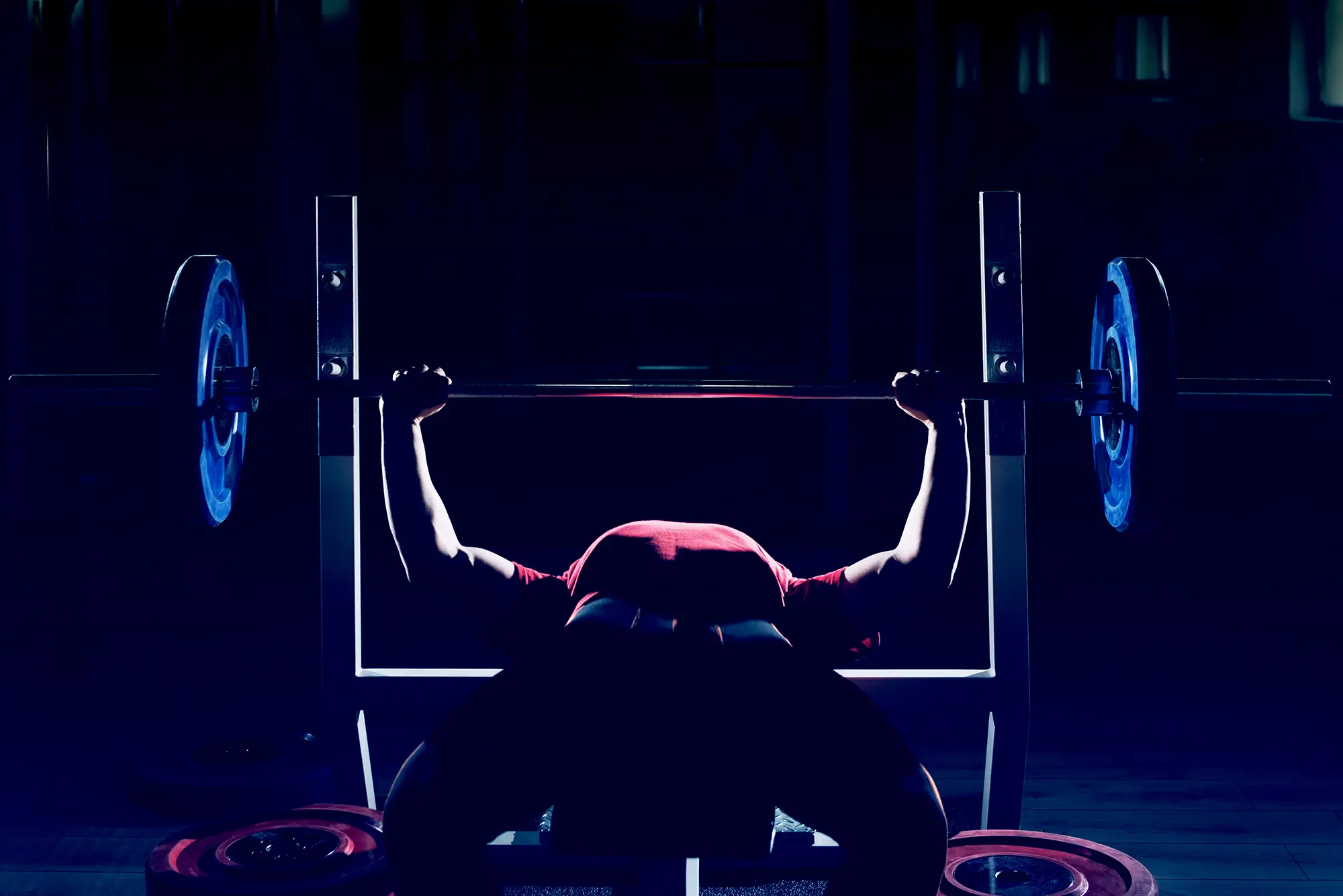
In this study, participants performed velocity-based training on the bench press for eight weeks across various combinations of intensity and proximity to failure. Higher intensities produced greater strength outcomes, while sets taken closer to failure favored hypertrophy. So is it as simple as more intensity for greater strength and more reps for more muscle? Let's find out.
Overview
- What did they test? One hundred and fifty-eight resistance-trained males were split into 12 groups and performed eight weeks of bench press training. Groups trained in differing combinations of intensity ranges (40–55% 1RM, 55–70% 1RM, and 70–85% 1RM) and velocity loss per set (0%, 15%, 25%, and 50%). They were tested for a variety of outcomes, including cross-sectional area (CSA) of the pectoralis major, maximal dynamic strength (1RM), and isometric strength.
- What did they find? When grouped by intensity, all measured ranges improved both strength and hypertrophy. When grouped by velocity loss, all thresholds improved both strength and hypertrophy (noting CSA was not assessed in the 40–55% 1RM group). The 70–85% 1RM group produced the greatest gains in both strength and hypertrophy, while 25% velocity loss produced the greatest strength gains and 50% velocity loss produced the greatest hypertrophy gains.
- What does it mean for you? Based on these findings, moderate to heavier loads (in this case 70–85% 1RM) appear beneficial regardless of your training goal. For strength, it’s better to pair this intensity with moderate proximity to failure, stopping before fatigue accumulates too heavily. For hypertrophy, the same loading range applies, but pushing closer to failure produced better muscle growth outcomes.
What’s the Problem?
In January 2025 we covered an article by Robinson et al. 1 where a meta-regression was performed to quantify the dose-response relationship between proximity to failure and strength and hypertrophy outcomes. They found that while training closer to failure resulted in greater hypertrophy outcomes, this was not observed for strength gains, and these findings appeared to be independent of training intensity.
Previous meta-analyses have also demonstrated that hypertrophy outcomes are largely similar across a range of loading intensities when sets are taken to failure. However, perhaps unsurprisingly, 1RM strength gains appear to favor higher loads 2. This suggests that while muscle growth may be achievable across a broad spectrum of intensities, maximizing strength likely requires heavier training.
While we broadly accept that heavier loads favor strength and higher volumes favor hypertrophy, much of this evidence comes from research that didn't control for how fatiguing each session actually was. Velocity loss thresholds provide a repeatable, objective measure of proximity to failure that can be applied across a range of training loads 3, producing more repetitions at lower intensities and fewer at higher ones. The current study was, according to the authors, the first to match different levels of fatigue accrual across intensity conditions using velocity loss, offering a more controlled test of whether these assumptions hold up.
Purpose
The study aimed to compare eight weeks of bench press training across different intensity ranges and velocity loss combinations on a range of strength and hypertrophy-related outcomes.
Hypothesis
The authors hypothesized that their highest intensity range (70–85% 1RM) combined with the greatest velocity loss (50%) would produce the greatest hypertrophy outcomes, while the same intensity with moderate velocity loss (25%) would produce the greatest strength improvements.
What Did They Test and How?
If you would like to continue reading...
New from Biolayne
Reps: A Biolayne Research Review
Only $12.99 per month
- Stay up to date with monthly reviews of the latest nutrition and exercise research translated into articles that are easy for anyone to understand.
- Receive a free copy of How To Read Research, A Biolayne Guide
- Learn the facts from simplified research
About the author

Hayden Pritchard
Dr. Hayden Pritchard holds a PhD from the Auckland University of Technology (AUT), his thesis was titled "Tapering Strategies to Enhance Maximal Strength". He has published numerous research articles in international journals, presented at the Australian Strength and Conditioning Associations International Conference, and worked as an academic for around eight years. As an athlete, he...[Continue]
More From Hayden