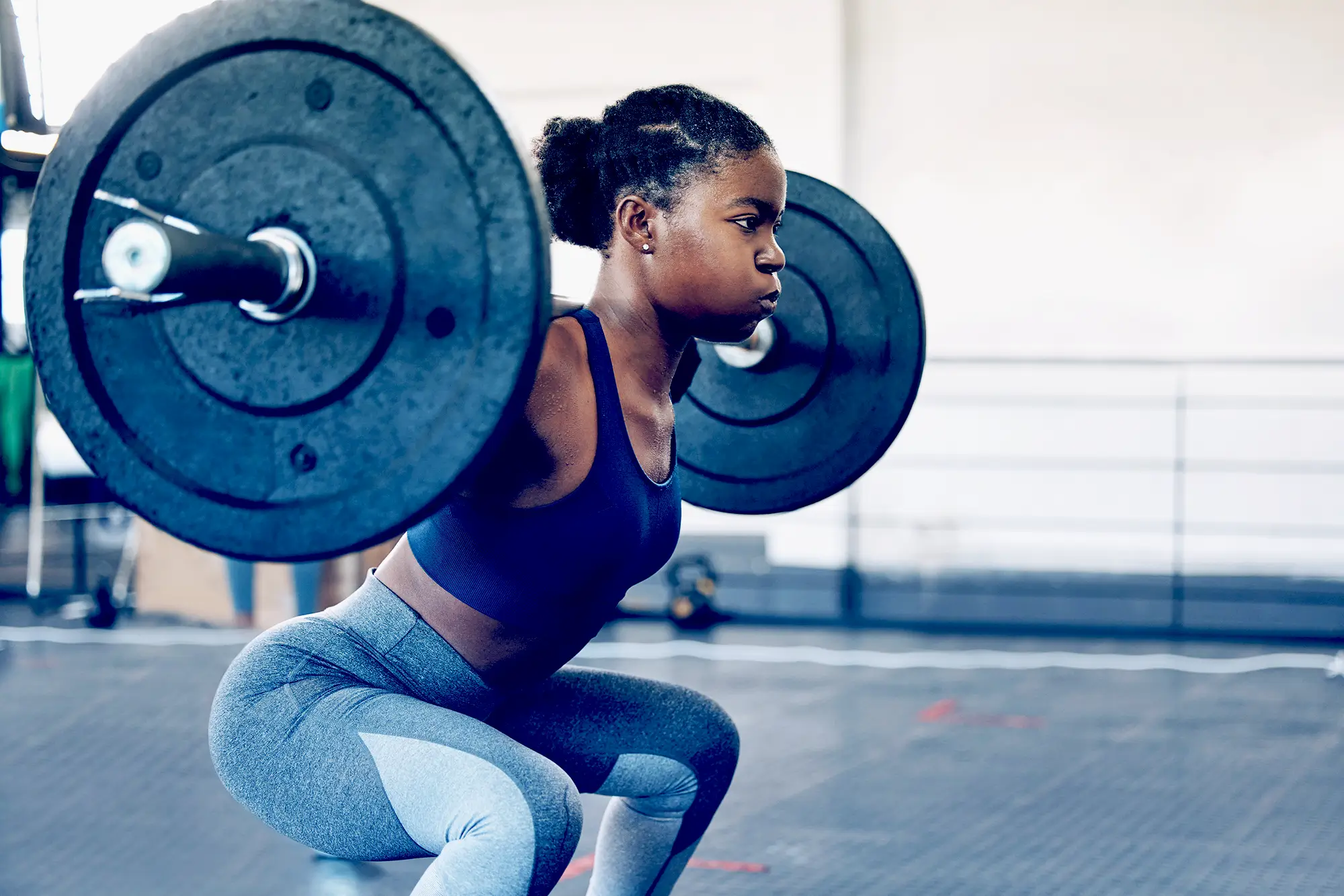
More repetitions normally means more fatigue, which has left the volume literature somewhat unclear on which of the two primarily influences adaptation. An 8-week trial pried them apart by inserting a short rest before every single repetition, extended whenever bar speed started to drop. Thirty-six trained men squatted twice weekly at 70–85% of 1RM, accumulating 48, 144, or 312 total repetitions across the program. The lowest-volume group performed three reps per session — and appeared to match the others in muscle growth and maximal strength. Volume did separate the groups, but not where you might expect.
Overview
- What did they test? The authors aimed to explore whether training volume drives adaptation when associated fatigue is minimized. Thirty-six moderately strength-trained men were split by baseline 1RM into low (48 total reps), moderate (144), or high (312) volume groups. All squatted twice weekly for 8 weeks (one set/session) at 70–85% 1RM. Rest was placed between every repetition: starting at 10 s, extended up to 80 s if mean propulsive velocity (MPV) dropped ≥ 0.04 m·s⁻¹ below the session's best. Outcome measures included vastus lateralis CSA/volume (ultrasound), estimated 1RM, submaximal bar velocity, countermovement jump, maximal isometric force and RFD, fatigue performance, and surface electromyography (EMG).
- What did they find? No hypertrophy differences emerged. All groups increased CSA and muscle volume similarly (p = 0.08–0.96; ES: 0.41–0.56). Estimated 1RM also rose similarly by 13.7–16.4% (p = 0.75). Volume only separated groups in submaximal bar velocity (favoring moderate volume, p = 0.02) and muscle activation (favoring high volume). The high-volume group had the largest EMG gains and uniquely improved maximal isometric force, though it started with roughly half the baseline EMG amplitude of the other groups. Conversely, the low-volume group's EMG fell during fatigue testing.
- What does it mean for you? Six relatively fast, and heavy squat repetitions weekly produced similar results as thirty-nine per week for vastus lateralis growth and estimated 1RM. Crucially, the low-volume warm-up added ascending sets up to 80% 1RM, making its true dose higher than three repetitions per session. Furthermore, with n=12 per group, non-significant findings might reflect undetected differences—such as the trend for greater growth at the proximal CSA site in the high volume group—rather than proven equivalence. Ultimately, when inter-repetition rest keeps bar speed high, the extra repetitions in the moderate and high volume group appeared to primarily drive velocity and activation adaptations across this timeframe rather than significantly more muscle growth overall.
What’s the Problem?
Training volume is among the most studied variables in resistance training, and among the hardest to study cleanly. Volume and fatigue are confounded by design; performing more repetitions within a set means more fatigue accumulates across them, so any adaptation credited to volume might equally reflect the fatigue that came along with it. The authors of the presently reviewed study put the problem plainly — it remains uncertain whether the driver of adaptation is fatigue, volume, or the interaction between both. They note that while a number of studies have compared different training volumes 1 2 3, none controlled for the fatigue that a given volume necessarily generates.
That confound sits underneath the velocity-loss literature this study builds on. Velocity loss (VL) — the decline in bar speed from the fastest repetition of a set to the last, expressed as a percentage — serves as a real-time index of within-set fatigue, because bar velocity falls predictably as effort accumulates. Pareja-Blanco et al. 4 is the reference point throughout this study's narrative: four VL thresholds (0%, 10%, 20%, 40%), 8 weeks of squat training at 70–85% of one-repetition maximum (1RM), three sets per session with four minutes between sets. The present authors characterize that study as showing an inverted U-shaped relationship, with 10–20% VL producing greater strength and jump improvements than 40% VL. The authors speculate that exceeding this VL range might result in a level of fatigue beyond which returns diminish.
Pareja-Blanco et al. reported no significant between-group differences in sprint, jump, or strength gains, while their hypertrophy group × time interaction approached what is classically recognized as statistical significance (p = 0.06). So, the inverted U is an ordering of effect sizes and within-group significance, not a demonstrated between-group dose-response. It matters here because the entire premise of the present study is inherited from it: the 48, 144, and 312 repetition totals are lifted directly from the 0%, 20%, and 40% VL conditions of that trial.
The authors' unique design in this study was to attempt to keep fatigue roughly the same across groups while letting volume differ. They did it by adding a short rest before every repetition, so each rep was performed at about the same speed as the one before it. The idea builds on cluster-set research they cite: Ortega-Becerra et al. 5, on how different cluster arrangements affect performance and muscle activation, and Tufano et al. 6, on how those arrangements affect metabolic, hormonal, and perceived-effort responses. This research group had already run this design in the bench press 7, and they describe that study as showing the same inverted U, with moderate volumes producing the best strength gains. It's worth knowing what that study actually found: no significant group × time interaction on any variable. The moderate-volume group simply posted the largest effect sizes on most strength measures — an ordering, not a demonstrated difference. That leaves the question open for the squat, which the authors argue is a different problem: more muscle mass involved, more neuromuscular demand, and different mechanical and metabolic stress than a bench press. Whether volume affects strength, muscle growth, and neuromuscular adaptation the same way in a lower-body, multi-joint lift is what this study set out to test.
Purpose
The authors aimed to investigate the effects of three squat-based resistance training programs with varying volumes but controlled by fatigue through the use of short inter-repetition rest periods on strength performance, neuromuscular adaptations, and muscle hypertrophy.
If you would like to continue reading...
Reps: A Biolayne Research Review
Only $12.99 per month
- Stay up to date with monthly reviews of the latest nutrition and exercise research translated into articles that are easy for anyone to understand.
- Receive a free copy of How To Read Research, A Biolayne Guide
- Learn the facts from simplified research
About the author

Cody Haun
Cody Haun completed his Bachelor's and Master's Degrees at East Tennessee State University where he studied Exercise and Sport Physiology alongside his work as a strength and conditioning coach. During this time, Cody developed a keen interest in physiology and nutrition. Cody went on to complete his PhD from Auburn University with a concentration in...[Continue]
More From Cody